
Ancient, my buddy
Your buddy misses you
(Please be sure to listen to the Bing Crosby song at the end)
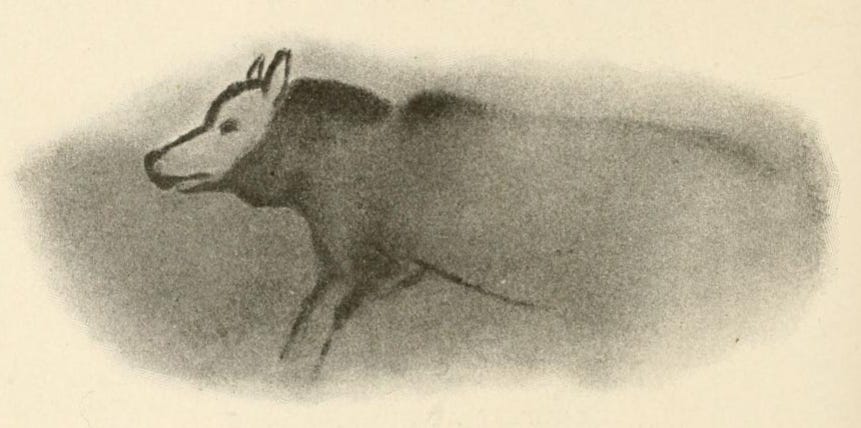
In France 26,000 years ago, an eight-year-old boy and his wolf-dog walked together 150 feet into a cave with a torch to light the way. He and his dog were likely up to some mischief because the cave was considered sacred; off-limits probably to little kids and dogs. The boy just wanted to see what the adults were talking about: realistic paintings of horses, lions, rhinoceros, and bison. The two friends made footprints in the soft, lime-mud floor and sometime after their visit, a landslide sealed the cave’s entrance until it was found by three French speleologists in 1994. The Chauvet Cave contains some of the oldest and most beautiful wall paintings ever found, some as old as 35,000 years. Werner Herzog was allowed to film these paintings for his documentary, Cave of Forgotten Dreams.
Dogs are our most ancient companions. They know our facial expressions, our moods and much of our language. We understand their faces as well, their moods, and we also understand their many different barks, chuffs, pants and growls most of which they never use around other dogs, only on us.
When these loyal companions age, suffer and die, it affects us physically, our grief is palpable. This is now my family’s state: mourning for our family dog of 15 years. He was a powerful, 90-pound beast in his prime, jealous of company, wary of women and hated egg yolks. He suffered from separation anxiety and would howl a mournful song when one of us left the house.
But age overtook him, and one night last week he collapsed in the backyard. After 10 minutes of struggle, I tried to roll him onto a blanket and without warning he crushed my hand in his still formidable jaws, sinking a canine deep into my palm. I knew it was bad, but I shrugged off the pain and helped get him back inside.
By morning, my right hand had swollen into a hot throbbing balloon, leaking a foul, fishy odor from the wound. I spent the next three days in the hospital receiving intravenous antibiotics.
Miserable as I was, I had no anger. My old dog lashed out the only way he knew how. I worried, though, that he would pass while I was in the hospital or that his condition would worsen leaving my wife to deal with a euthanasia alone. But he hung in there, tough old boot that he was. He waited for me.
When I sat near him again, he was a happy dog, but nearly paralyzed, only able to pull his head up to greet me. Later that night his lungs failed him. Large dogs often pass this way, and hearing their struggle to breathe is frightful and sad, nothing I wanted my wife to endure, and so we had a vet help him to that distant shore.
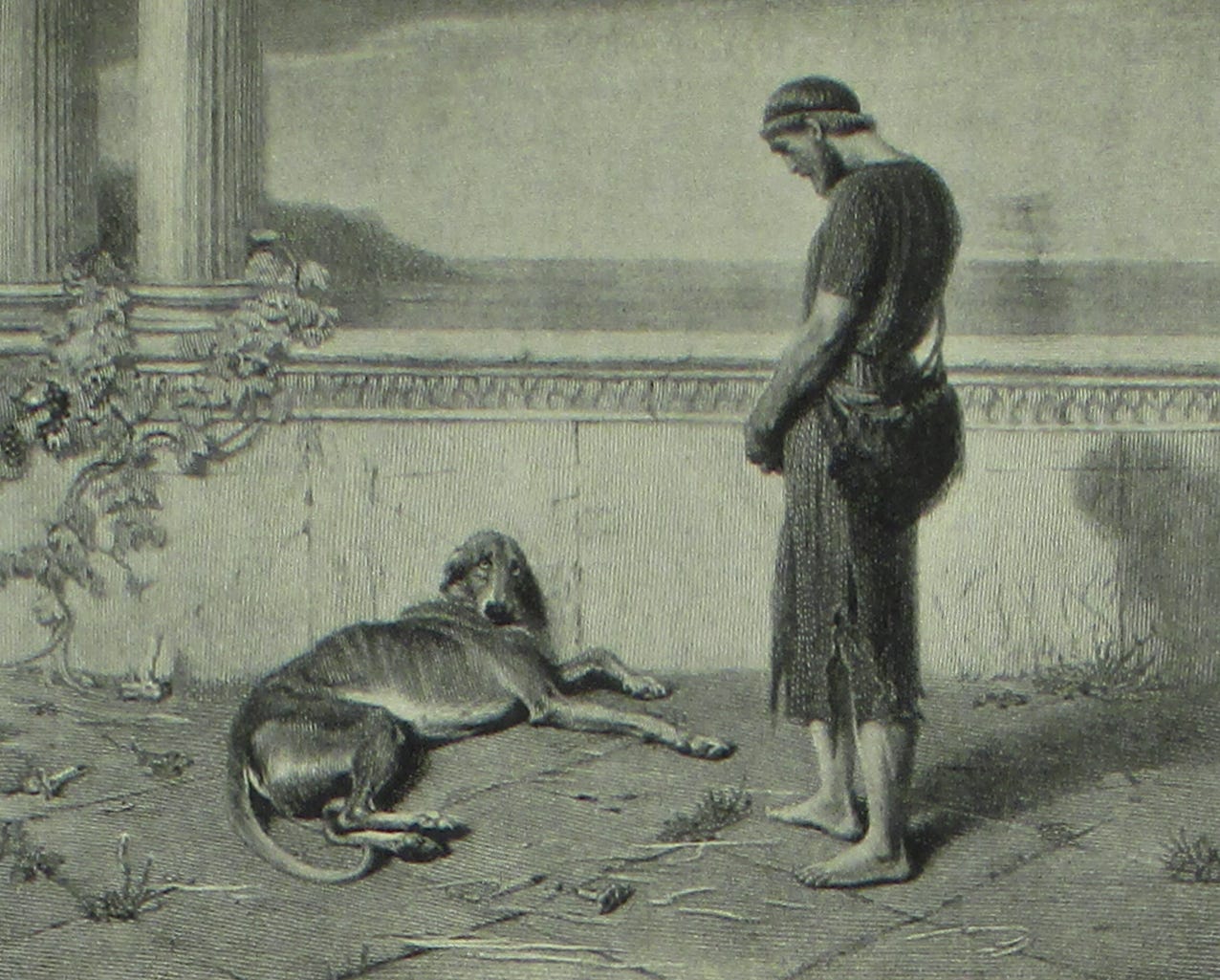
My buddy waited for me, like noble Argos. Eight hundred years before Christ, Odysseus shed tears for his old friend who waited for his master’s return to Ithica. Argos recognized his master, despite his disguise; the only one to do so.
Dogs see through our disguises, you know.
Thus, near the gates conferring as they drew,
Argus, the dog, his ancient master knew:
He not unconscious of the voice and tread,
Lifts to the sound his ear, and rears his head;
Bred by Ulysses, nourish'd at his board,
But, ah! not fated long to please his lord;
To him, his swiftness and his strength were vain;
The voice of glory call'd him o'er the main.
Till then in every sylvan chase renown'd,
With Argus, Argus, rung the woods around;
With him the youth pursued the goat or fawn,
Or traced the mazy leveret o'er the lawn.
Now left to man's ingratitude he lay,
Unhoused, neglected in the public way;
And where on heaps the rich manure was spread,
Obscene with reptiles, took his sordid bed.
He knew his lord; he knew, and strove to meet;
In vain he strove to crawl and kiss his feet;
Yet (all he could) his tail, his tears, his eyes,
Salute his master, and confess his joys.
Soft pity touch'd the mighty master's soul;
Adown his cheek a tear unbidden stole,
Stole unperceived: he turn'd his head and dried
The drop humane: then thus impassion'd cried:
"What noble beast in this abandon'd state
Lies here all helpless at Ulysses' gate?
His bulk and beauty speak no vulgar praise:
If, as he seems, he was in better days,
Some care his age deserves; or was he prized
For worthless beauty? therefore now despised;
Such dogs and men there are, mere things of state;
And always cherish'd by their friends, the great."
"Not Argus so, (Eumaeus thus rejoin'd,)
But served a master of a nobler kind,
Who, never, never shall behold him more!
Long, long since perish'd on a distant shore!
Oh had you seen him, vigorous, bold, and young,
Swift as a stag, and as a lion strong:
Him no fell savage on the plain withstood,
None 'scaped him bosom'd in the gloomy wood;
His eye how piercing, and his scent how true,
To wind the vapour on the tainted dew!
Such, when Ulysses left his natal coast:
Now years unnerve him, and his lord is lost!
The women keep the generous creature bare,
A sleek and idle race is all their care:
The master gone, the servants what restrains?
Or dwells humanity where riot reigns?
Jove fix'd it certain, that whatever day
Makes man a slave, takes half his worth away."
This said, the honest herdsman strode before;
The musing monarch pauses at the door:
The dog, whom Fate had granted to behold
His lord, when twenty tedious years had roll'd,
Takes a last look, and having seen him, dies;
So closed for ever faithful Argus' eyes!
Harry, I am so sorry for you loss. I know how much we love them and what a gap it leaves in our lives when they go. I'm glad he waited for you (and glad you are okay!).
Beautiful, heartfelt tribute.